The Great Sand Debate: Is M-Sand Inferior Successor to River Sand in Modern Construction?
by Babu George
Originally published on February 28, 2026, 6:23 pm, updated on March 02, 2026
scroll down- Introduction: The Sand Crisis
Sand is the second most consumed natural resource in the world after water. Yet, few people realize that the construction industry is facing a global sand crisis. Unregulated River Sand Mining has devastated river ecosystems across India, Southeast Asia, and Africa. Reports from the United Nations Environment Programme highlight severe impacts including riverbank erosion, falling groundwater tables, habitat destruction, and saline water intrusion in coastal regions [Source: UNEP Sand Sustainability Report].
In India, illegal sand extraction—often linked to the so-called “sand mafia”—has led to ecological imbalance and infrastructure damage. Bridges have collapsed due to excessive riverbed mining [Source: Central Water Commission Report].
Despite this crisis, many traditional builders cling to the belief that Manufactured Sand (M-Sand) is inferior to natural river sand. This “Inferiority Myth” stems from habit, not data. Contractors fear that M-Sand contains excessive dust, reduces strength, or compromises durability.
The reality? M-Sand is not merely a substitute. It is an engineered, quality-controlled upgrade designed for modern Concrete Mix Design and performance-based construction.
- Technical Anatomy: How M-Sand is Made
Unlike river sand, which is naturally weathered over thousands of years, Manufactured Sand is produced in a controlled industrial environment using advanced crushing technology.
The key equipment is the Vertical Shaft Impactor (VSI) crusher. VSI technology accelerates rock particles against a wear-resistant anvil or rock bed, producing:
- Cubical particle shape
- Controlled gradation
- Optimized Fineness Modulus
- Low and regulated Silt Content
This precision engineering ensures consistency across batches.
River sand, by contrast, is:
- Random in particle size distribution
- Often contaminated with clay, shells, and organic matter
- Highly variable in Fineness Modulus depending on the source
As per Bureau of Indian Standards specification IS 383:2016 – Coarse and Fine Aggregates for Concrete, fine aggregates must meet strict grading and impurity limits [Source: IS 383:2016]. M-Sand plants are designed to comply with these gradation zones (Zone II preferred for structural concrete).
ALSO READ: Making Buildings Safe During the Rainy Season: Waterproofing and Monsoon Safety Tips
Technical Parameters to Consider:
- Fineness Modulus (FM): Ideal range 2.6–3.0 for concrete [Source: IS 383].
- Silt Content: Should not exceed 3–5% depending on usage [Source: IS 2386].
- Particle Shape: Angular particles enhance mechanical interlock.
- Gradation: Continuous gradation reduces voids and cement demand.
- Busting the Strength & Durability Myth
One of the biggest misconceptions is that concrete made with river sand is stronger. Let’s examine the data.
Multiple comparative studies have shown that compressive strength of concrete made with M-Sand is equal to or slightly higher than that of river sand when properly graded [Source: IIT Madras Research on M-Sand].
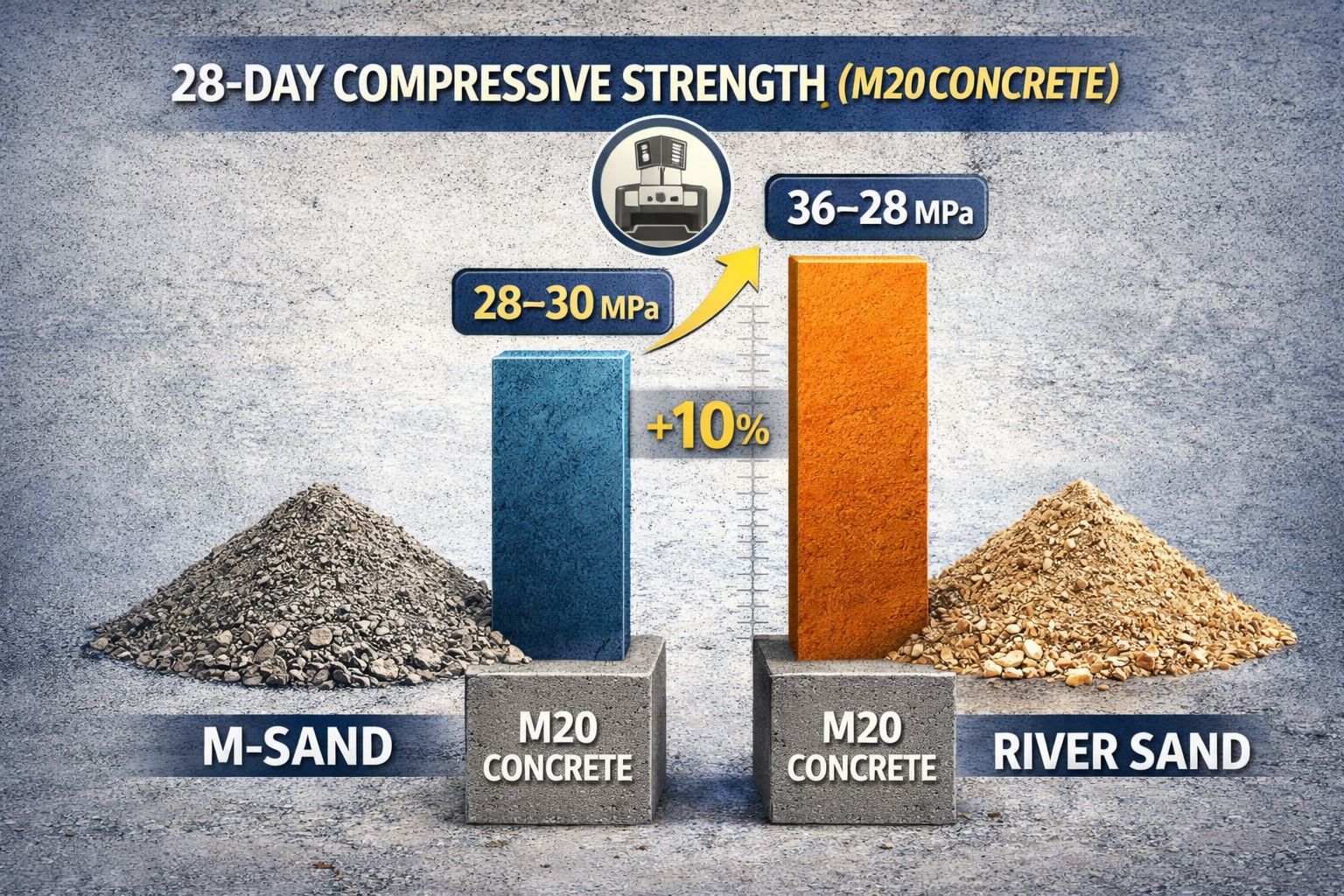
28-day strength Comparison M-and Vs. River Sand
For example:
- M20 Grade Concrete (28-day strength)
- River Sand: ~26–28 MPa
- M-Sand: ~28–30 MPa
[Source: Academic Comparative Studies]
Why does this happen?
- Superior Bond Strength
M-Sand particles are angular and rough-textured. This enhances:
- Surface area contact
- Mechanical interlocking
- Adhesion with cement paste
River sand particles are rounded due to erosion. While this improves workability, it reduces bond strength.
Workability & Pumpability: The Angularity Trade-Off
While angular particle shape improves bond strength and mechanical interlock, it also increases internal friction within fresh concrete.
Compared to rounded river sand:
-
M-Sand mixes can feel “harsh”
-
Slump may reduce at same water content
-
Pumping pressure may increase in high-rise construction
In high-rise projects using boom pumps:
-
Increased pipe friction can cause blockages
-
Wear on pump lines may increase
-
Higher pumping energy may be required
However, modern concrete technology addresses this through:
✔ Use of superplasticizers (IS 9103 compliant admixtures)
✔ Optimized sand-to-aggregate ratio
✔ Proper fines control
✔ Pump mix design adjustments
When designed correctly, M-Sand concrete can achieve equal or superior pumpability compared to river sand mixes.
The key takeaway: M-Sand demands engineering discipline — not blind substitution.
ALSO WATCH: Paint flaking on the walls solved! No more dreaded flaking walls!
- Absence of Organic Impurities
River sand often contains:
- Clay lumps
- Silt (sometimes 15–20%)
- Organic matter
- Shell fragments
These contaminants:
- Increase water demand
- Reduce compressive strength
- Cause shrinkage cracks
As per IS 383:2016 – Coarse and Fine Aggregates for Concrete, fine aggregates must comply with grading zones and limits on deleterious materials including clay lumps, coal, lignite, and fines passing the 75 micron sieve.
Testing methods are governed by:
-
IS 2386 (Part I to VIII) – Methods of Test for Aggregates for Concrete
-
IS 456:2000 – Plain and Reinforced Concrete Code of Practice
As per ASTM International standard ASTM C33, fine aggregates must meet limits for deleterious substances [Source: ASTM C33].
M-Sand, when produced in compliance with IS 383, is washed and screened to remove micro-fines beyond permissible limits.
Micro-Fines Beyond IS Limits: The Real Engineering Risk
It is important to clarify a critical technical nuance.
While controlled micro-fines (<75 micron) improve particle packing, excess micro-fines beyond IS 383 permissible limits can negatively affect performance.
As per IS 383:2016, the permissible percentage of fines passing 75 micron sieve is generally:
-
Up to 3–5% for concrete sand
-
Higher limits may apply depending on grading zone and testing compliance
[Source: IS 383:2016, BIS]
When micro-fines exceed limits:
-
Surface area increases significantly
-
Water demand increases
-
Workability reduces
-
Risk of shrinkage cracks increases
If additional water is added without adjusting cement content or admixture dosage, the effective water-cement ratio increases — leading to:
-
Lower compressive strength
-
Reduced durability
-
Increased permeability
Therefore, performance superiority of M-Sand depends on:
✔ Proper washing
✔ Sieve analysis compliance
✔ Controlled fines content
✔ Scientifically designed Concrete Mix Design
The material is not the issue. Non-compliance is.
- Reduced Voids = Optimized Cement Consumption
Well-graded M-Sand reduces void content in concrete, improving density and durability.
Durability parameters improved with M-Sand include:
- Lower permeability
- Higher abrasion resistance
- Reduced chloride ingress
[Source: Concrete Durability Research Publications]
- The Sustainability Angle: ESG and Green Building
Sustainable Construction is no longer optional. It is an ESG mandate.
Environmental Impact of River Sand Mining:
- Riverbed deepening lowers groundwater tables.
- Aquatic biodiversity is destroyed.
- Increased flooding risk due to bank erosion.
- Salinity intrusion in coastal regions.
[Source: UNEP & Central Water Commission]
Many state governments in India have restricted or banned river sand extraction.
Why M-Sand is Sustainable
- Produced from hard granite or basalt rock.
- Often a byproduct of the aggregate crushing industry.
- Zero dredging impact on rivers.
- Controlled dust management systems.
From a green building perspective:
- Contributes to material transparency credits.
- Supports local sourcing (reduces transport emissions).
- Reduces ecological damage footprint.
Projects targeting certification under Indian Green Building Council (IGBC) or U.S. Green Building Council (LEED) can leverage responsibly sourced Manufactured Sand to improve sustainability metrics [Source: IGBC/LEED Material Credit Guidelines].
In the era of Construction Trends 2026, ESG-driven procurement will favour engineered materials over environmentally destructive extraction.
ALSO READ: Discover The Future of Exterior Wall Paints: Introducing Mineral Silicate Technology in India
- Economic Realities: Cost-Benefit Analysis
From a project management perspective, cost predictability is critical.
Price Stability
River sand pricing fluctuates due to:
- Seasonal monsoon bans
- Government crackdowns
- Transportation restrictions
M-Sand pricing is more stable because:
- It is factory-produced.
- Supply chains are structured.
- Production can scale with demand.
Important Note: Poorly graded M-Sand without proper quality control can increase cement consumption by 3–8% due to higher water demand. Therefore, procurement must be specification-driven rather than price-driven.
Usability Factor
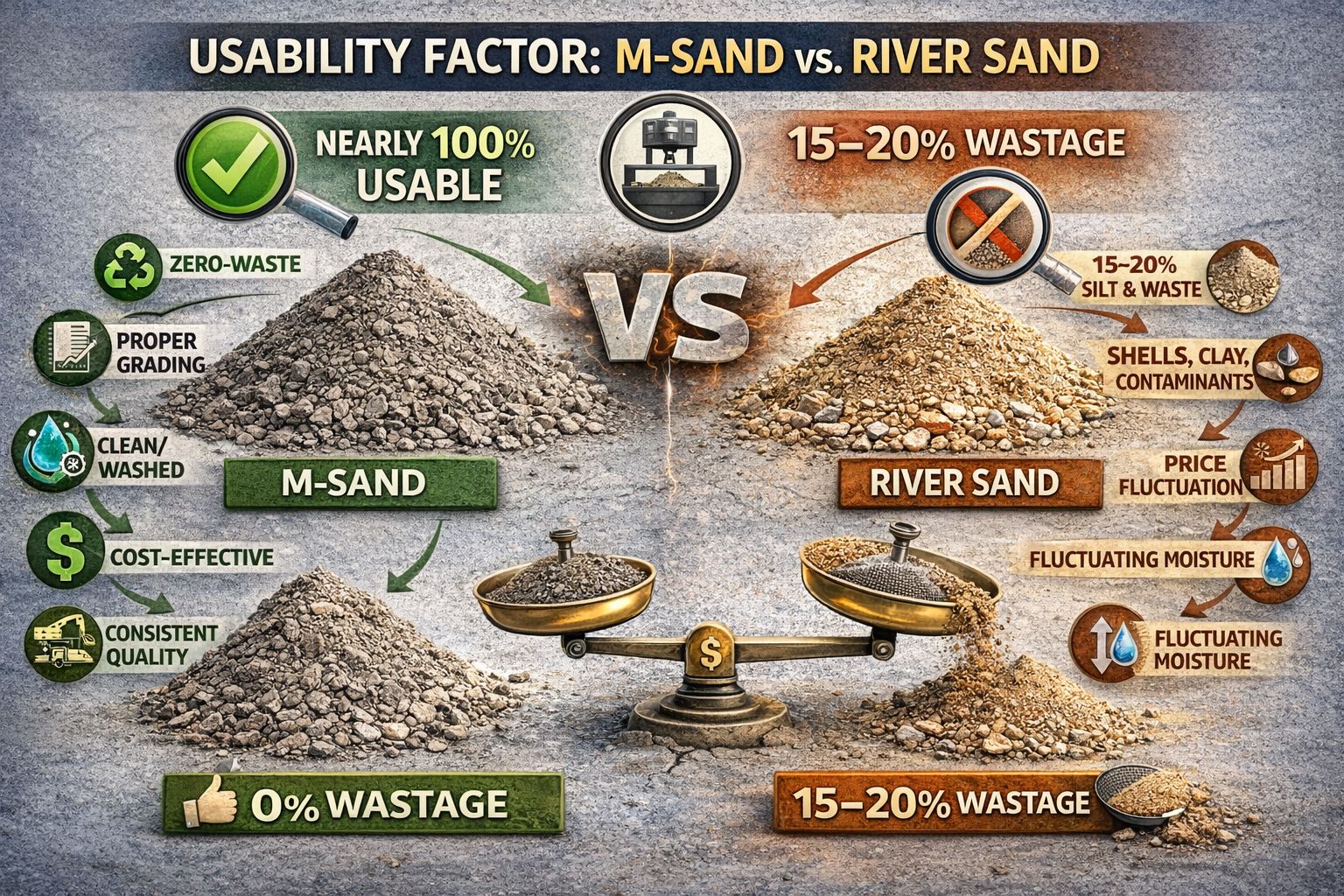
River sand may contain:
- 15–20% silt and waste [Source: Field Studies & Lab Tests]
- Moisture variation causing batching inconsistencies
M-Sand is nearly 100% usable material after washing and grading.
Project-Level Impact
In a mid-to-large-scale residential development:
- Fine aggregate may account for 8–12% of total material cost.
- Even a 5% savings in wastage can reduce total project cost by 1–2%.
Additionally:
- Reduced rework due to better quality control.
- Lower cement consumption due to optimized gradation.
- Predictable concrete performance.
For developers managing large portfolios, this translates into measurable EBITDA improvements.
- Addressing Common Concerns: The “Dust” Factor
The most frequent objection is: “M-Sand has too much crusher dust.”
This concern is valid—but only if the supplier lacks proper washing and classification systems.
Types of M-Sand:
- Concrete M-Sand: Conforms to Zone II grading.
- Plastering M-Sand: Finer gradation for smooth finishes.
- Washed M-Sand: Reduced micro-fines through hydro-cyclone washing.
Permissible micro-fines (<75 micron) are regulated under IS 383 and IS 2386 [Source: BIS].
On-Site Quality Check: The Glass Jar Test
A simple field method:
- Fill a transparent jar with sand and water.
- Shake vigorously.
- Let it settle for 3–4 hours.
- Observe silt layer thickness.
If silt exceeds permissible percentage (usually >5%), reject the batch.
Professional projects should also insist on:
- Sieve analysis reports
- Silt test certificate
- Bulk density test results
Quality assurance is not about material type—it is about compliance.
ALSO WATCH: PU Injection Grouting for basements & Negative side Waterproofing
- The Global Shift: Government & Regulatory Stance
Governments worldwide are tightening regulations on river sand extraction.
In India, multiple states have:
- Imposed mining restrictions.
- Mandated M-Sand use in public works.
- Encouraged mechanized sand production units.
Infrastructure projects—bridges, highways, metros—are increasingly adopting Manufactured Sand as standard practice [Source: Ministry of Road Transport & Highways Circulars].
This policy shift reflects global sustainability commitments and infrastructure resilience strategies.
- The Verdict
The debate is no longer emotional—it is empirical.
Manufactured Sand offers:
- Higher and more consistent strength
- Controlled quality under IS and ASTM standards
- Environmental responsibility
- Economic predictability
Choosing M-Sand is not a compromise. It is a forward-looking decision aligned with Sustainable Construction, performance-driven Concrete Mix Design, and ethical resource management.
The future of fine aggregate is engineered, not extracted.
And the future is already here.
Disclaimer
The information presented in this article is intended for general educational and informational purposes only. While every effort has been made to ensure technical accuracy, data references, and compliance with applicable standards such as IS 383, IS 2386, and ASTM C33, material performance may vary depending on source quality, manufacturing processes, mix design, workmanship, and site conditions.
Readers are advised to:
-
Conduct proper laboratory testing before material approval.
-
Obtain certified test reports from suppliers.
-
Consult qualified structural engineers and material specialists before making procurement decisions.
-
Verify compliance with applicable local building codes and regulatory requirements.
The author and publisher assume no liability for project outcomes arising from the application of the information provided herein. Decisions regarding material selection should be based on site-specific evaluation, engineering judgment, and applicable statutory guidelines.